Posts

Showing posts with the label black hole

31. Ehrenfest Paradox 2: Does the length of a rotating circumference change?

Image
  We looked at the Ehrenfest paradox last time. There are two issues in the Ehrenfest paradox. The first assumes a disc made up of an ideal rigid body, but when rotated at relativistic speed, it ruptures. The second is that the perimeter of a rotating body is different from its length when it is stationary. In the last post I looked at the first issue, and this time I want to look at the second issue. For those who have not read the first part, I will briefly introduce this paradox. It is best to read the previous post. Below is a link to the first part. The Ehrenfest paradox part I Rotating disc and length contraction   In relativity, objects that run very fast are said to shrink in length. So the official name of this is Lorentz - Fitzgerald Length contraction. It is not 'Einstein's length contraction'. This was born regardless of the theory of relativity. Before the theory of relativity was published, several people experimented to detect ether, but the...

23. Confrontation of black hole and length contraction

Image
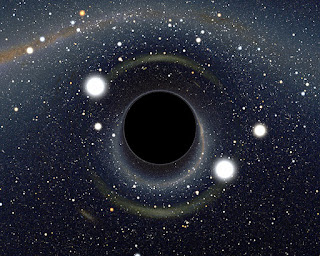
   A black hole is a very gravitational star. So black holes devour the surrounding matter, and even light cannot escape them. There is a singular point in the very center of a black hole. When an object is sucked into this singularity, its appearance is very strange.    As the object is sucked into the black hole, it is sucked into the singular point as the length increases infinitely by tidal gravity in the vicinity of the horizon. This part is very characteristic. In the theory of length contraction, however, this is a little bit different. In length contraction theory, when the speed of an object reaches a relativistic speed, the length approaches zero. It means that it gets very short. This part collides head-on with the explanation that the length of the black hole is increased by tidal gravity to infinity. So, now I will ask you a question. When an object falls into a black hole, Does the length of the object shrink to zero? Or is it stretchin...

22. The singularity of the black hole and the length contraction.

Image
The meteoroids in outer space come into our atmosphere crashing and collide with into the earth. Objects that fall into the sun with more gravity than earth are quickly sucked into the flames of the sun. Needless to say, in the case of a black hole that has more gravity than the earth or the sun, all objects are sucked into the singularity of the black hole. However, if the theory of length contraction is correct, the story is a little different. If the length contraction is truly correct, all objects are gathered on the horizon of the black hole event, and nothing falls into the singularity of the black hole. This is not true, and if the length contraction is correct, it is. An object that passes through the horizon and faces a singular point is infinitely stretched due to the tidal gravity of the black hole. This is also the opposite of the theory of length contraction. If the length contraction is correct, the singularity of the black hole cannot exist, and if the sing...